For the past two years, the story in Asia Pacific venture capital has been one of retrenchment. Deal values trended lower through 2023 and remained subdued through 2024, despite some quarter-to-quarter volatility, while fundraising slowed sharply and the region's investors turned cautious. Q2 2026 is the first quarter since the downturn began that meaningfully shifts the narrative.
According to PitchBook's latest data, APAC venture deal value reached USD 50.9 billion in the second quarter of 2026 — up 53% on the previous quarter and 150% higher than the same period a year earlier. It's the highest quarterly figure since Q1 2022 (which was marginally higher on an unrounded basis) — meaning APAC deal value hasn't been this strong in four years. For a market that had spent two years adjusting to a much tighter funding environment, that's a meaningful signal.
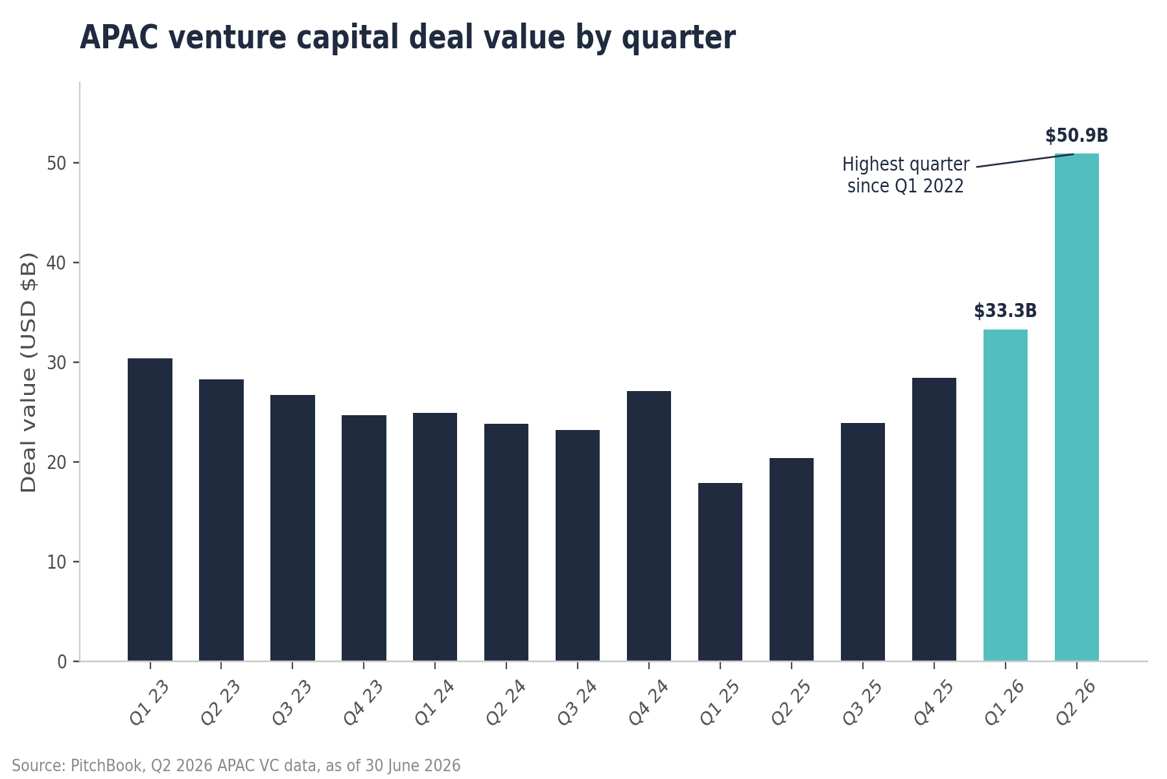 APAC venture capital deal value by quarter
But the headline number only tells part of the story. Look closer, and the shape of this recovery says as much as its size.
Bigger cheques, not more of them
Deal count in the region hasn't moved anywhere near as much as deal value. Including PitchBook's estimated additions for late-reported deals, the quarterly deal count was little changed — 4,108 in Q1 2026 versus 3,865 in Q2 2026 — even as deal value jumped 53% over the same period. In other words, this isn't a broad-based return of risk appetite across the venture landscape — it's capital concentrating into a smaller number of larger rounds.
That pattern is consistent with what we're seeing globally, where later-stage and growth-stage rounds — many tied to AI infrastructure and applications — are absorbing an outsized share of available capital. For investors, it reinforces a thesis that has held up well through this cycle: conviction and selectivity matter more than breadth. In a market where capital is chasing a narrower set of opportunities, quality of access and disciplined underwriting become increasingly important.
Exit value is outpacing exit volume
The exit environment tells a similar story. APAC exit value rose to USD 56.9 billion in Q2 2026, up 70% year-on-year, while the actual (reported-to-date) exit count fell from 180 a year earlier to 152. That gap narrows once late-reported exits are added in — so the more defensible read isn’t "fewer exits," but that exit value is climbing considerably faster than exit volume, suggesting that larger individual transactions are driving much of the increase in exit value.
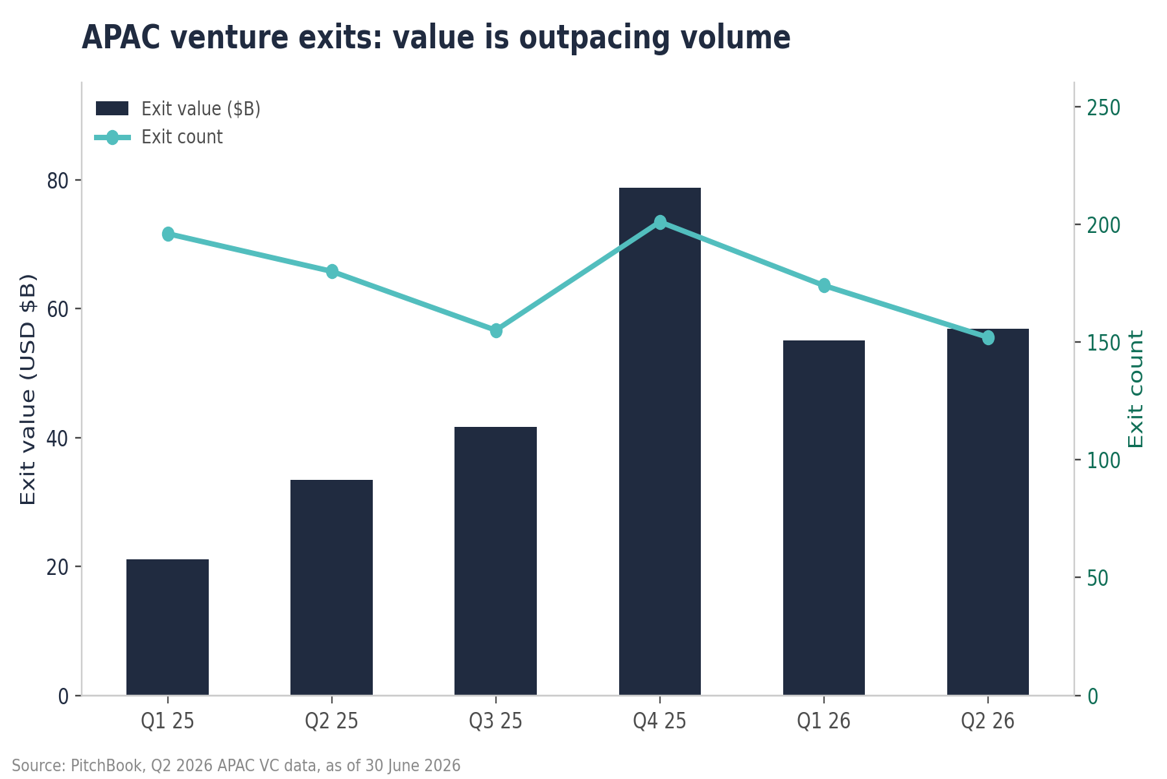 APAC venture exits: value vs. count
For limited partners thinking about distribution timelines, this matters. A market where exit value is growing faster than exit volume can still deliver strong outcomes for portfolios built around a select number of high-conviction positions, even if the overall pace of liquidity events across the ecosystem stays measured.
Fewer managers are raising capital right now
Perhaps the most striking figure in the data isn't about deals at all — it's about fundraising. APAC venture fund count fell from 589 in 2025 to just 212 in the first half of 2026, with capital raised on pace for a fraction of last year's total. Put simply, far fewer venture managers are currently in the market raising new funds.
For allocators, periods when fewer managers are fundraising often present an opportunity to be more selective. Rather than navigating hundreds of competing raises, investors can spend more time assessing managers with differentiated strategies and demonstrated track records.
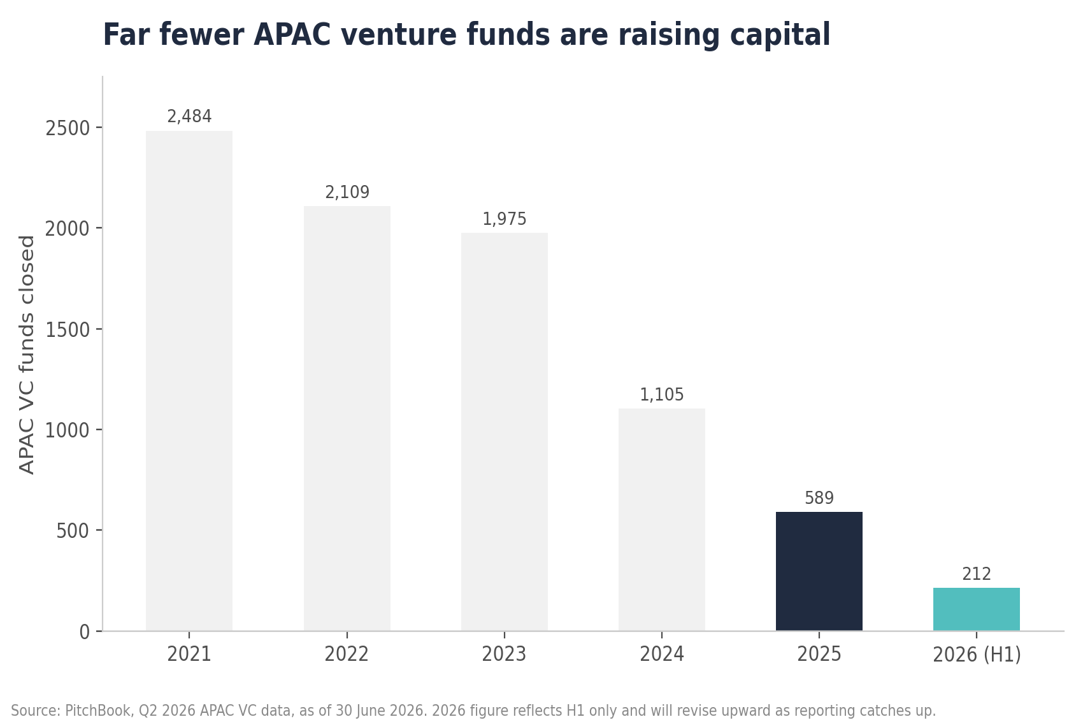 APAC VC fund count, 2021–2026 (H1)
APAC's share of global activity, in context
Zoom out to the global picture, and the Q2 number takes on another dimension. PitchBook's Global VC data shows global deal value at USD 227.5 billion in Q2 2026; APAC's USD 50.9 billion represents roughly 22% of that total, up sharply from an unusually low 10% share in Q1 2026 (USD 33.3 billion of a USD 332.9 billion global total). That said, 22% is still below the levels APAC held through most of the 2016–2024 period, when its share often sat above 25%, and at times considerably higher — the low shares of the past two quarters largely reflect a surge in global deal value elsewhere, rather than APAC losing ground outright. The Q2 rebound shows a recalibration of APAC's contribution to global venture activity, rather than a new high.
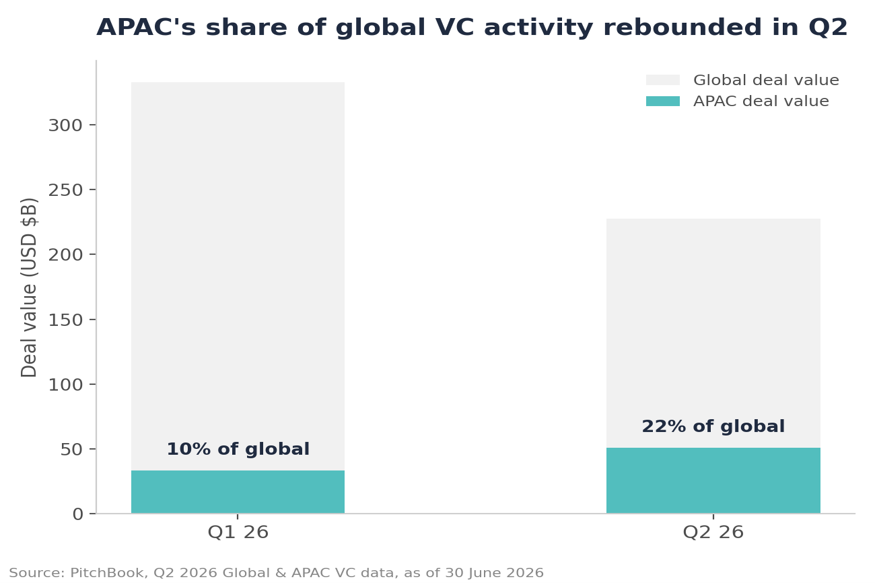 APAC share of global VC deal value
What this looks like in practice
At Aura Ventures, we've seen many of these themes play out within our own portfolio. Haast, the AI-powered brand and regulatory compliance platform we initially backed at the pre-seed stage, has grown rapidly since its founding in 2023. Its enterprise customers now span retail, financial services and telecommunications, and the company has raised close to USD 20 million, including a USD 12 million Series A led by Peak XV Partners in 2026, with continued support from existing investors.
Isaacus, the Melbourne-based legal AI foundation model company whose 2025 pre-seed round was led by Aura Ventures, has established itself as one of Australia's emerging leaders in legal AI in a remarkably short time. Its Kanon 2 models currently rank first on both the Legal RAG Bench and the Massive Legal Embedding Benchmark (MLEB), two open benchmarks Isaacus itself has built and maintains for evaluating legal AI models, and its early design-partner program has included organisations such as Harvey, KPMG Law, Clifford Chance and Clyde & Co. The team is also behind semchunk, an open-source text-processing library adopted by organisations including Microsoft and IBM.
Most notably, both teams, Liam King and Kunal Vankadara of Haast, and Umar Butler and Abdur-Rahman Butler of Isaacus, were named to the Forbes 30 Under 30 Asia AI Class of 2026, making Aura Ventures portfolio companies four of the founders recognised among just five Australian-founded companies in this year's AI category.
While two companies don't define a market, they do illustrate the broader pattern emerging in the data. Even in a more selective funding environment, founders building differentiated deep technology continue to attract capital, customers and industry recognition. That's the type of company Aura Ventures has sought to back since the beginning.
The takeaway
None of this means the venture cycle has definitively turned. One strong quarter doesn't erase two years of caution, and the data itself is still provisional for the most recent period — deal and exit counts, in particular, will be revised upward as reporting catches up.
At Aura Ventures, we've long believed that venture returns are driven less by broad market momentum than by disciplined manager selection, deep founder relationships and access to differentiated opportunities across Australia and Southeast Asia. The latest data doesn't change that philosophy, but it does suggest the environment may increasingly reward it.
Markets rarely announce turning points with certainty, but they often leave clues. Bigger rounds, improving exit values and a more disciplined fundraising environment suggest APAC venture capital may be entering a different phase of the cycle. For investors with a long-term horizon, that's worth paying attention to.
Source: PitchBook, Q2 2026 APAC VC and Global VC data, as of 30 June 2026.