Global markets remain resilient despite rising oil prices and economic uncertainty driven by the US/Israel-Iran war.

This outlook contains information correct as at 1400hr on 05 May 2026
War Trumps Tariffs as the Bigger Threat
IMF's chief economist warns of a global recession, indicating that the US/Israel-Iran war has created far bigger risks than President Trump's initial wave of steep tariffs a year ago. The World Economic Outlook's most optimistic "reference scenario" assumes a short-lived Middle East conflict and forecasts 3.1% Global GDP growth for 2026, down 0.2 percentage points from its January forecast. Under this scenario, oil prices average USD82 per barrel in 2026, down from above USD100 per barrel for WTI. Excluding the Middle East violence, it would have upgraded growth to 3.4%, due to the continued technology investment boom, lower interest rates, less severe US tariffs and fiscal support in some countries.
Stock markets across Asia Pacific and Europe have rebounded, closing at or near all-time highs as investors moved past fear and refocused on earnings. Last week, US markets reached record highs, with the S&P 500 (7,272.5) and Nasdaq (25,223) up 0.6% and 1.5%, respectively, supported by strong corporate earnings. The large US banks seem to be paving the way for a strong Q1 season. All these against a background of geopolitical uncertainty surrounding the US/Israel – Iran war, with the closure of the Straits of Hormuz pushing up oil prices and pressuring supply chains.
Historically, stock markets lead economic growth by six to nine months. Stocks are expecting oil prices and supply chain pressures to ease off going into 2027. About 11% of non-oil trade and 20% of oil passes through the Straits of Hormuz. In the months to come, alternative routes may be found, and if that happens, the Straits may lose their importance as the World adapts.
Fed Holds, But Cracks Are Showing
In April, the US Federal Reserve kept its Federal Funds Target Rate unchanged in the 3.50%-3.75% range at its third consecutive meeting. However, the 8–4 vote, the most dissent since 1992, underscores a deep policy divide within the Committee. Kevin Warsh is expected to replace him as Chairman, and Powell confirmed that he will remain on the Board as a Fed Governor after his term as Chair ends in mid‑May. Fed watchers now expect an extended pause followed by one cut in Q4.
The potential succession of Kevin Warsh as the next Federal Reserve Chairman has created uncertainty. Warsh’s past tenure (2006 - 2011) as a Fed Governor suggests he is a monetary policy hawk, with his focus on inflation, a smaller Fed balance sheet, less forward guidance, and an emphasis on the Fed’s independence. However, being nominated and favoured by President Trump may put his previous thinking into question.
China’s 15th Five-Year Plan emphasises tech self-reliance and domestic demand, with AI breakthroughs in infrastructure and computing efficiency remaining a key focus. Leading AI & internet firms are positioned for long-term growth, supported by policy tailwinds and innovation.
Big Oil Warns, But Supply Is Rising
Big Oil bosses are warning that energy prices are approaching the point of no return. Government leaders are crisscrossing the Asia-Pacific to offer and secure energy supplies and supply chains; for example, Australia has offered to supply LNG in exchange for refined oil products. Over the last nine weeks, the US exported 250 million barrels, overtaking Saudi Arabia as the world’s largest exporter. US shale oil and Latin American producers are starting to ramp up supply, so energy prices are likely to be contained.
Rates & the Dollar
With the USD Index DXY hovering around 98.50 from 100.00 on 7 Apr. the USD is likely to maintain its strength for the rest of the year.
Overnight, US 10-Year Treasuries closed unchanged at 4.44% (7 Apr 4.34%), Australian 10-Year Govt Bonds closed up 0.02% at 5.0% (7 Apr 4.99%), and Euro 10-Year Bonds closed up 0.05% at 3.09% (7 Apr 2.99%).
Sources: Bloomberg, MSNBC, Reuters, Morningstar, Business Times, 05 May 2026
Currency Focus
AUDUSD
The latest inflation figures (March CPI) showed inflation accelerated. Headline CPI rose 4.6% YoY, well above the RBA’s 2–3% target band, driven almost entirely by a 32.8% fuel spike from Middle East supply disruptions. Trimmed mean (Core inflation) came in at 3.3% YoY, still above target. Persistent high Core inflation should limit the RBA’s ability to look through the current spike and may be supportive of AUDUSD in the coming months, with AUD now having a significant interest rate differential over USD.
At its recent MPC meeting, the RBA raised the OCR by 0.25% to 4.35% as widely expected, signalling that its tightening cycle may be over for the short term.
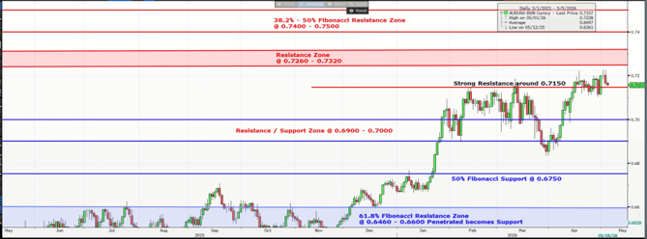
AUDUSD did not drop back as we expected, but continues to try to establish above the strong Resistance at 0.7150. AUDUSD may try to push up and challenge the Resistance Zone at 0.7260 – 0.7320, but may fail and drop back below 0.7150 towards the Support Zone at 0.6900 – 0.7000.
Image Source: Bloomberg 05 May 2026
EURUSD
At its April meeting, the ECB kept interest rates unchanged for the seventh consecutive time. The deposit facility rate remains at 2.00%, the main refinancing rate at 2.15%, and the marginal lending facility rate at 2.40%. The accompanying press release offered little new guidance for financial markets. But ECB President Christine Lagarde signalled a rate hike could be considered as early as June. However, geopolitical risks for the EuroZone and the negative impact of the Middle East conflict on growth may weigh on EU growth, which should weigh on EURUSD.
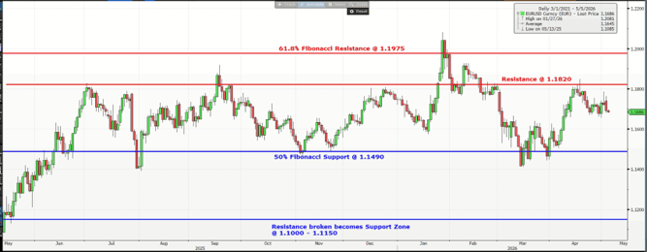
EURUSD consolidated at the 1.1490 50% Fibonacci Support area and pushed higher to test Resistance at 1.1820. We may see EURUSD test this Resistance again, but maintain a view for another drop back towards 1.1490 and below.
Image Source: Bloomberg 05 May 2026
GBPUSD
As expected, the BOE left its Bank Rate unchanged at 3.75% on 30 Apr. In the Monetary Policy Summary and Minutes, the BOE stated “the Committee will continue to monitor closely the situation in the Middle East and how its impact propagates through the economy”, adding that it “stands ready to act as necessary to ensure that CPI inflation remains on track to meet the 2% target in the medium term”. A leading think tank warned that Britain is facing a GBP35 billion economic hit and the risk of a recession this year as the fallout from the war in Iran adds to the pressure on Keir Starmer’s government.
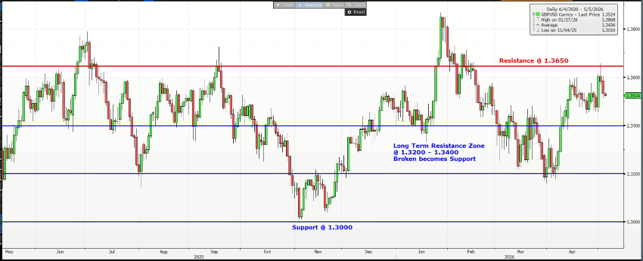
Contrary to expectations, the 1.3200 Support held, and GBPUSD rallied towards Resistance at 1.3650. We may see a test of this Resistance again, but GBPUSD is expected to fall back towards the 1.3400 Support. Over the next few months, GBPUSD should range trade between 1.3200 and 1.3650.
Image Source: Bloomberg 05 May 2026
USDJPY
At its meeting last Thursday, 30 Apr, the BoJ kept its policy rate unchanged at 0.75% in a 6–3 vote. It reaffirmed the next move might be a rate hike but offered no further guidance. On the same day, the Ministry of Finance, through the BoJ, intervened in the USD/JPY market, reportedly spending around USD 34.5 billion to prop up the JPY. According to a Bloomberg analysis of central bank accounts, this is the first intervention since July 2024.
“I would say the intervention was effective as it brought the Yen down to around 155 per dollar. But I don’t think they are out of the woods yet,” said Takahide Kiuchi, executive economist at Nomura Research Institute and a former Bank of Japan board member.
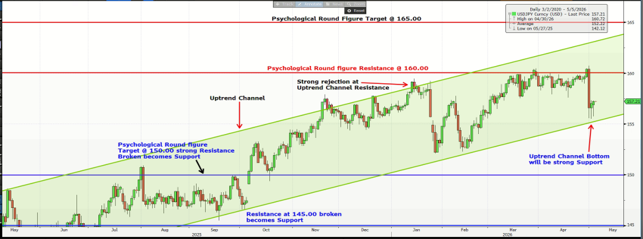
BoJ’s intervention was perfectly timed as USDJPY was trying to break above the strong psychological resistance level of 160.00. USDJPY has fallen sharply but remains within the Uptrend Channel and should be well supported at the Channel Bottom. Over the next few months, we expect USDJPY to trade within this Channel with an upwards bias.
Image Source: Bloomberg 05 May 2026
USDSGD
The Monetary Authority of Singapore (MAS) tightened for the first time since 2022 at its MPC meeting on 14 Apr. It announced a slight increase in the slope of the Singapore Dollar Nominal Economic Exchange Rate (S$NEER) policy band (market estimates from 0.5% p.a. to 1.0% p.a.), with no changes to the width or the level at which the band is centred. It raised its 2026 core inflation forecast range to 1.5%–2.5% from 1.0%–2.0%. Singapore’s economy continued to exhibit resilience, with a slight -0.3% QoQ pullback in Q1 following three earlier quarters of robust sequential expansion, translating to a 4.6% YoY growth in 2025.
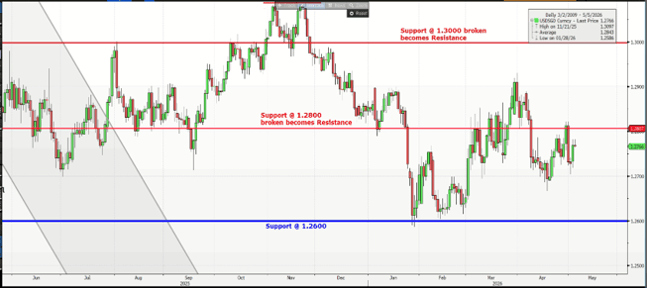
USDSGD’s drop below 1.2800 was sharper than expected. USDSGD is likely to consolidate between 1.2600 and 1.2800 in the coming weeks with a downward bias.
Image Source: Bloomberg 05 May 2026
AUDSGD
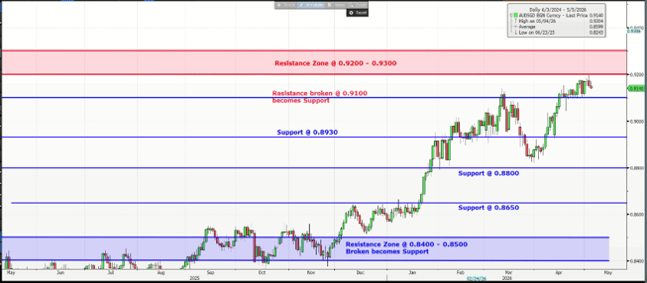
The expected consolidation between 0.8800 – 0.8930 did not happen, and AUDUSD broke through Resistance at 0.9100 to test the upper Resistance Zone at 0.9200 – 0.9300. Momentum has weakened, and we are consolidating around 0.9100 before a fall back towards 0.8930.
Image Source: Bloomberg 05 May 2026
XAUUSD
Even with the geopolitical and economic uncertainties of the last few months, Gold has not been able to rally. XAUUSD has dropped through and remained below the 50-Day Moving average, which is now a strong Resistance. The technical wave count targets USD 4,000 as the next Support area.
Image Source: Bloomberg 05 May 2026
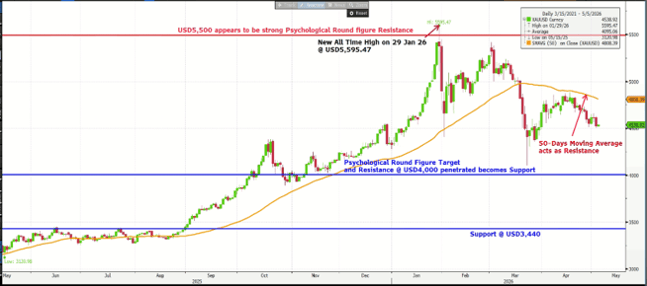
Note: In the Candlesticks Chart, Green bars mean the Close is higher than the Open price, and Brown bars mean the Close is lower than the Open price