April CPI

Australia’s April CPI data eased pressure on the Reserve Bank of Australia (RBA) to deliver another interest rate rise at its June meeting, with headline inflation cooling faster than expected to 4.2% from 4.6% in March. The moderation was largely driven by lower fuel prices following the federal government’s temporary fuel excise reduction. However, underlying inflation remains elevated, with trimmed mean CPI rising to 3.4%, its highest level since late 2024 and well above the RBA’s 2–3% target band.
The data highlighted how government interventions are complicating the inflation picture. Fuel excise cuts and free Victorian public transport lowered headline inflation, while the expiry of electricity rebates pushed up household energy costs. These temporary measures are masking broader inflationary pressures rather than eliminating them.
Housing and transport remained the largest contributors to inflation, rising 6.3% and 6.6%, respectively. The ABS also noted that higher oil prices linked to the Middle East conflict are beginning to spread beyond petrol into freight, construction materials and logistics-related services.
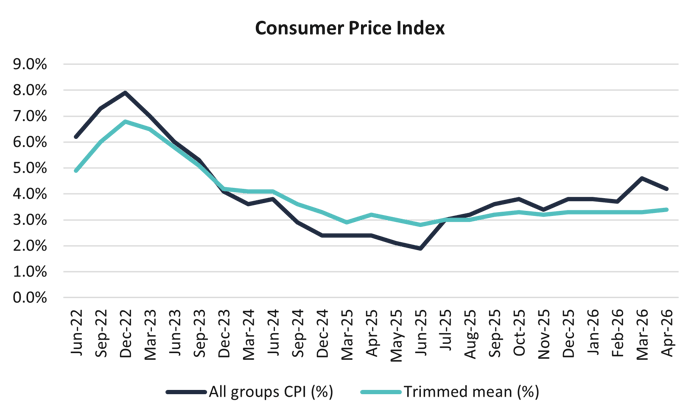
Markets now expect the RBA to keep the cash rate on hold at 4.35% in June following three consecutive rate rises. However, economists continue to warn that delayed second-round effects from higher fuel and business costs could keep inflation elevated and leave the door open to a further rate rise later this year, potentially in August.
The inflation data arrives alongside signs of weakening economic momentum. Australia’s unemployment rate recently rose to 4.5%, its highest level in more than four years, pointing to some cooling in labour market conditions whilst business sentiment and growth has also eased.
Overall, the April CPI report provided short-term relief on headline inflation but reinforced that underlying inflation pressures remain persistent, with geopolitical risks and fuel-related cost pass-through continuing to cloud the outlook for monetary policy.
Source: Australian Bureau of Statistics, Consumer Price Index, Australia, May 2026.