GDP and National Accounts

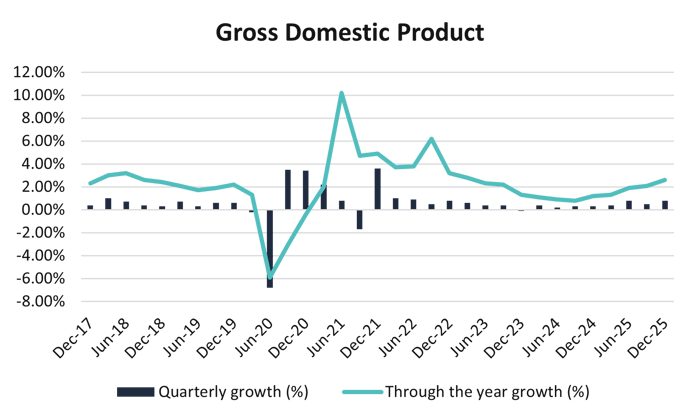
Australia’s latest national accounts release from the ABS indicates the economy ended 2025 with stronger momentum than previously expected, complicating the near-term outlook for monetary policy. Real GDP expanded 0.8% quarter-on-quarter in the December quarter, lifting annual growth to around 2.6% and pointing to an economy that continues to expand at a solid pace despite restrictive financial conditions. However, the domestic outlook is unfolding against a more uncertain global backdrop, with escalating tensions in the Middle East pushing oil prices higher and raising the risk of renewed imported inflation pressures.
Growth in the December quarter was supported by a rebound in mining output, continued strength in public demand and steady private investment. Government spending and infrastructure investment remained key contributors to activity, while household consumption expanded more modestly as higher interest rates and cost-of-living pressures continued to weigh on discretionary spending. Overall, the data suggest the economy is growing close to, or slightly above, its potential rate despite the tightening cycle.
The strength of the national accounts adds complexity to the RBA's outlook. This week, Governor Michele Bullock emphasised that every policy meeting remains “live”, pushing back against the market assumption that the board would wait for quarterly CPI data before making further adjustments. Markets interpreted the remarks as a hawkish signal, now fully pricing at least one further increase by May.
External developments add an additional layer of uncertainty to the outlook. Escalating geopolitical tensions in the Middle East, particularly disruptions to shipping and energy markets following recent military exchanges involving Iran, have pushed global oil prices higher and raised the prospect of a renewed energy-driven inflation shock. Economists warn that petrol prices in Australia could rise significantly if supply disruptions persist, which would feed directly into headline inflation and inflation expectations.
Source: Australian Bureau of Statistics, Australian National Accounts: National Income, Expenditure and Product, Australia, March 2026.