PRIVATE WEALTH
Monthly Forex Outlook - October 2025
Global risk sentiment held steady as financial markets chose to ignore the third US Government shutdown under President Trump’s watch.
As 2026 unfolds, amid greater global uncertainties than in previous years, means success should come to those who fuse mastery of power geopolitics, economics, capital markets, and financial management.
This outlook contains information correct as at 1400hr on 06 Jan 2025
As 2026 unfolds, amid greater global uncertainties than in previous years, means success should come to those who fuse mastery of power geopolitics, economics, capital markets, and financial management. Interdisciplinary competence has become a strategic asset and its absence a recipe for potential failure.
After a slight improvement in December, US Consumer Confidence plunged to 84.5 in January (Dec 94.2), resuming its downward slide to the lowest level in 12 years as Americans worry about the nation’s economy, inflation and a weakening labour market. Dana Peterson, Chief Economist at the Conference Board, said consumers often mentioned price increases of oil, gas and groceries. Economists project the labour market will largely remain stagnant this year, with limited job opportunities, and fewer Americans expect their incomes to rise in 2026.
The US Federal Reserve’s FOMC meeting last Wednesday, 28 January, was a non-event. As expected, the Fed Funds target rate range was held steady at 3.50% to 3.75%. In its FOMC statement, the Fed upgraded both the economic and employment outlooks. FOMC Chairman Powell said the economic outlook has “clearly improved”, and the jobs market showed signs of stabilisation. Fed policy should be on hold until after Jerome Powell’s scheduled departure as Chairman in May.
Trump has nominated former Fed Governor Kevin Warsh as the next Fed Chairman. He is seen as more hawkish than the other earlier-mentioned contenders, and if confirmed, will strengthen the Fed’s credibility in fighting inflation. This may lead to the unwinding of safe-haven assets and strengthen the USD.
China’s official PMIs unexpectedly slid back into contraction in January. China’s CFLP Manufacturing PMI fell 0.8 points to 49.3 in January (Bloomberg estimate 50.1, Dec: 50.1). The Non-Manufacturing PMI also dropped by 0.8 points to 49.4 (Bloomberg estimate 50.3, Dec: 50.2).
This affirms a continued poor outlook for the economy. The upcoming Lunar New Year holidays, beginning on February 15 and running through February 23, should further crimp manufacturing activity in countries celebrating the Holiday.
Equities had a good start to the year, but so have safe-haven assets, Gold and Silver, which have been hitting successive new highs. This indicates that risk appetite and hedging currently go hand in hand, i.e. don't put all your eggs in one basket.
The US recovery remains uneven, with no sign of a recession. China’s economy remains in bad shape. However, the equity markets in both countries keep reaching new highs. The question then is – are we heading towards the cliff?
Upcoming events to note:
4 Feb - ADP Employment figure for January. Bloomberg estimates +45,000 from +41,000 in Dec.
5 Feb - European Central Bank meeting and interest rate policy decision, followed byECB President Lagarde’s pressconference. Analysts polled by Bloomberg expect no change.
- Bank of England MPC meeting. Analysts polled by Bloomberg expect no change in the Bank Rate, which remains at 3.75%.
6 Feb - US January Non-farm Payrolls. Bloomberg estimates 70,000 from 50,000 in December. January Unemployment rate to remain at 4.4% same as Dec. (Likely to be postponed)
- PreliminaryUniversity of Michigan Consumer Sentiment index for February.
- Bloombergestimate 55.0 from 56.4 in Jan.
8 Feb - Japan General Election. All 465 seats of the House of Representatives, the lower house of the National Diet, will be up for election. This is a test of new Prime Minister Sanae Takaichi’s policies to date.
Oil had a wild ride over the last month due to the Iranian situation. However, with OPEC+ keeping energy markets well supplied, any geopolitical risk premium was negated. Several banks are warning of a potential glut amid continued expansion in non-OPEC output (US, Brazil, Canada, Guyana). This suggests that, without fresh geopolitical shocks, the upside for crude should be limited.
Overnight, US 10-year Treasuries closed unchanged at 4.27% (6 Jan: 4.17%), Australian 10-year government bonds closed up 0.03% at 4.83% (6 Jan: 4.78%), and Euro 10-year bonds closed up 0.02% at 2.87% (6 Jan: 2.87%).
By late January, the USD had sunk to a four-year low against a basket of currencies after President Donald Trump said the value of the dollar is “great”, but stabilised after US Treasury Secretary Scott Bessent said the administration supports a stronger currency. We should see volatility in the USD in the coming weeks.
Sources: Bloomberg, MSNBC, Reuters, Morningstar, Business Times, 03 Feb 2026
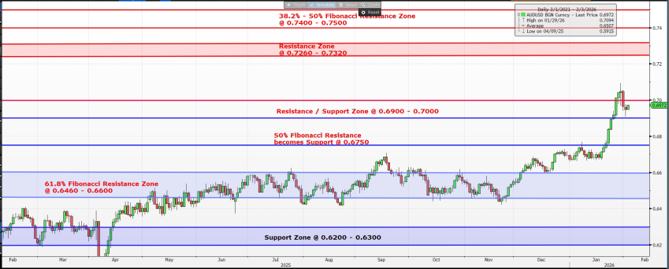
AUD/USD has spiked amid record Australian bond purchases, as investors shun the USD and the interest rate differential widens in favour of the AUD. An increasingly hawkish RBA is likely to raise interest rates, which will also underpin the currency. Australia’s annual inflation hit 3.8% in December 2025 (Nov: 3.4%), overshooting market expectations of 3.6%. The ABS December Labour Force report confirms employment surged by more than 65,000, pushing the unemployment rate down to 4.1%. Today, the MPC and RBA lifted the cash rate by 0.25% to 3.85% and signalled potential further tightening, as risks have shifted towards stronger-than-expected inflation and a tightening labour market.
Against expectations, AUD/USD continues to push higher, challenging the 0.6900–0.7000 resistance zone. We expect the rally to exhaust at this level, with a pullback to consolidate around 0.6900 before a decline towards 0.6750 in the coming weeks.
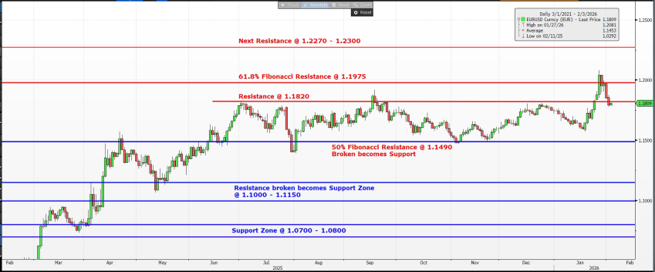
EURUSD
Risks for EUR/USD remain tilted to the downside, driven by ongoing French political uncertainties and the possibility that Germany’s ambitious fiscal plans face structural bottlenecks. Despite the EU–US trade agreement, the impact of US tariffs has yet to be felt across the broader economy.
Instead of consolidating, EUR/USD pushed higher before being repelled by the 61.8% Fibonacci resistance at 1.1975. Over the next few weeks, the pair is likely to head lower towards the 1.1700 area.
Image Source: Bloomberg 03 Feb 2026
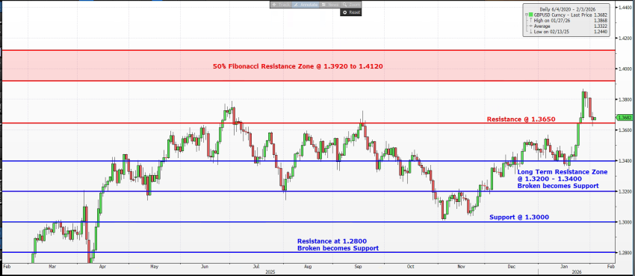
GBPUSD
GBP/USD is considered undervalued by some investors, but upside should be limited, as the UK faces unresolved economic, political, and social issues. The BoE is expected to cut rates cautiously on a quarterly basis until Q3, bringing the terminal Bank Rate to around 3.00% by year-end.
GBP/USD recently surged to a high above 1.3650, breaking through resistance; however, the sharp pullback over the past few days signals a loss of momentum. We expect the pair to fall back below 1.3650, followed by range trading between 1.3400 and 1.3650.
Image Source: Bloomberg 03 Feb 2026
USDJPY
At BoJ Governor Ueda’s press conference following the January 23 MPC meeting, he reaffirmed that the BoJ is likely to remain on its rate-tightening path. The BoJ is expected to hike by 0.25% in 2026, bringing the overnight call rate to 1.0% from the current 0.75%.
Japan heads to the polls on 8 February. The JPY may come under pressure after Prime Minister Sanae Takaichi remarked during a campaign rally that a weaker currency represents “a huge opportunity” for export-oriented industries, although she later retracted the comment. Markets, however, appear sensitive to her underlying stance.
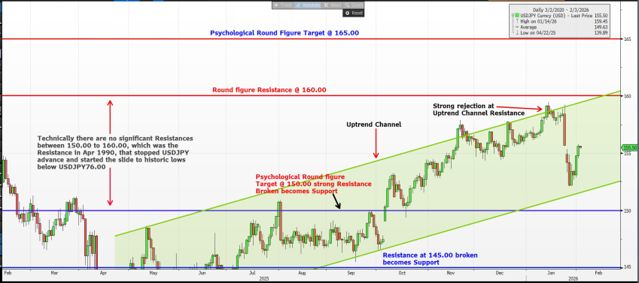
The deeper pullback in USD/JPY finally materialised after the pair failed to break above the uptrend channel top near 160.00. USD/JPY remains within the uptrend channel. Following a period of consolidation, and potentially a test of the channel base, we expect USD/JPY to resume its upward move.
Image Source: Bloomberg 03 Feb 2026
USDSGD
At its 30 January MPC meeting, the Monetary Authority of Singapore (MAS) maintained the prevailing rate of appreciation of the S$NEER (Nominal Effective Exchange Rate) policy band at 0.5%, with no changes to its width or the level at which it is centred. MAS is expected to steepen the slope to 1.0% either in April or July. The authority also raised its 2026 core and headline inflation forecast ranges to 1.0–2.0%, from 0.5–1.5% at the October 2025 meeting.
Singapore’s total foreign reserves rose to a record high of SGD 526.33 billion in December 2025, driven by increases in gold and foreign exchange reserves, as well as its IMF reserve position.
The SGD has hit its highest level in over 11 years against the USD and is expected to appreciate further.
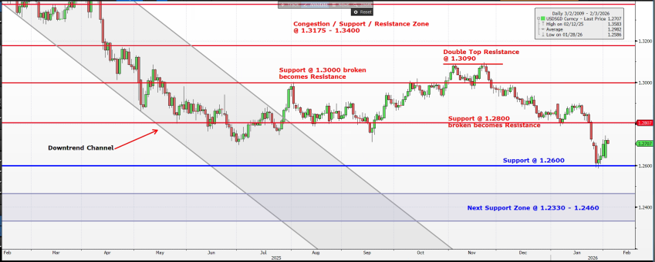
As expected, USD/SGD has reached and is now challenging the 1.2600 support. A period of consolidation is likely before USD/SGD moves lower to test the support zone at 1.2330–1.2460.
Image Source: Bloomberg 03 Feb 2026
AUDSGD
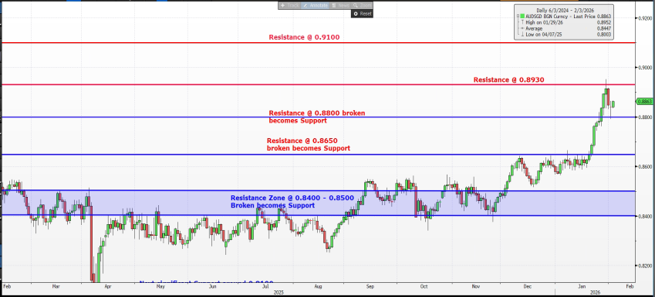
Contrary to our expectations of consolidation, AUD/SGD broke above the 0.8650 and 0.8800 resistance levels to challenge the 0.8930 resistance level. The strong rally now appears to have ended, and we expect AUD/SGD to consolidate between 0.8800 and 0.8930 over the coming weeks before a deeper pullback.
Image Source: Bloomberg 03 Feb 2026
XAUUSD
Gold and silver both delivered higher returns than equities in 2025, and their fundamental price drivers remain unchanged in 2026. However, given the market’s heavily overbought conditions, prices have entered a sharp pullback, shaking out many short-term speculative buyers. This correction should, in turn, provide buying opportunities for structuring longer-term investment portfolios.
World Gold Council data published in January showed that central banks bought nearly as much gold in late 2025 as they did in the first eight months of the year, with China among the largest buyers. This remains a key pillar supporting gold prices, as countries continue to hedge against the USD.
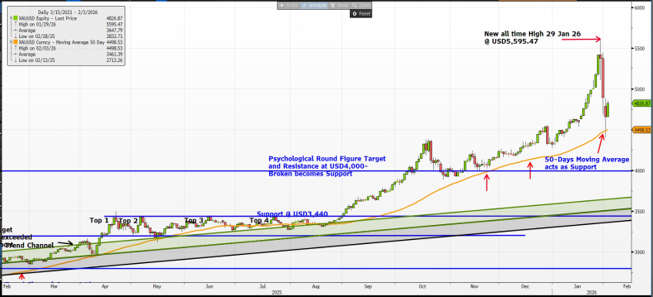
Gold pushed to a new high before undergoing a technical pullback to the 50-day moving average, albeit at a higher level below USD 4,500. We are likely to see consolidation between USD 4,200 and USD 5,000 before the next test of the recent high around USD 5,600.
Image Source: Bloomberg 03 Feb 2026
Note: In the Candlesticks Chart, Green bars mean the Close is higher than the Open price, and Brown bars mean the Close is lower than the Open price
Global risk sentiment held steady as financial markets chose to ignore the third US Government shutdown under President Trump’s watch.
Five years since inception, we've produced consistent monthly positive returns and Assets Under Management have grown more than 100% on an annualised...
Escalating US and Israeli strikes on Iran have rattled global markets, amplifying geopolitical and economic uncertainty into 2026 amid tariff...