PRIVATE WEALTH
Monthly Forex Outlook - March 2026
Escalating US and Israeli strikes on Iran have rattled global markets, amplifying geopolitical and economic uncertainty into 2026 amid tariff...
Global equity markets extend their record run as oil prices collapse, US jobs data disappoints, and the Fed holds rates steady amid lingering geopolitical uncertainty.

This outlook contains information correct as at 1430hr on 07 Jul 2026
European stocks rose to new records last Friday, with the Euro STOXX 50 closing 0.9% higher at 6,417 and the STOXX Europe 600 rising 0.7% to 653. In the US, the Dow closed last week at a new high of 52,900, while the S&P 500 and the NASDAQ remained near the top of their 2026 ranges. In the Asia-Pacific region, the volume of mergers and acquisitions is set to top USD 750 billion in 2026, with activity in sectors such as digital infrastructure and healthcare. Pushing aside geopolitical concerns, dealmaking has been strong worldwide, with global transaction values at USD 2.6 trillion and on course to surpass the 2021 record.
The Strait of Hormuz is effectively still closed. However, in our June Global Insights, we indicated that "the chart pattern shows oil prices will likely be lower in the coming months." Oil prices have since plummeted, with WTI trading at around USD 69 per barrel vs. USD 90 on 2 Jun.
Saudi Arabia is looking to sell its main crude oil at a big discount for buyers in Asia, the first time since it embarked on a price war in 2020, due to a surge in global supply. Saudi Aramco will lower Arab Light oil for next month by USD 11 a barrel to USD 1.50 below the regional benchmark. This marks the largest monthly reduction in official selling prices since at least 2000.
It looks like the energy crisis might no longer be a problem.
Trading was muted last Friday, as US markets were closed for the Independence Day holiday weekend (on Saturday, 4 July). On Thursday, the early release of US June employment data showed non-farm payrolls at 57,000, missing Bloomberg's estimate of 113,000, with a 74,000 downward revision to May and April jobs. The unemployment rate also surprised with a lower reading of 4.2%, due to a dip in the labour force, sending the participation rate to 61.5%, the lowest since March 2021.
A softer labour market with moderating oil prices should ease the inflation outlook. Markets are dialling back expectations for further Fed tightening to a hold through 2026. In June, as widely expected, with a unanimous vote (12–0), the Fed held its Fed Funds Target Rate at 3.50%–3.75% for a fourth time. The release of the June statement had a clear commitment: "The Committee will deliver price stability." However, Trump's war, with the ensuing uncertainty and price pressures, means US and global interest rates should remain at the high end for some time.
Under the 15th Five-Year Plan (2026–2030), China announced, at the opening of the 2026 Lujiazui Forum in Shanghai on 17 Jun, that it will expand the use of the RMB in international trade, investment, and financing. As such, the RMB internationalisation trend is likely to continue, although the pace has been slow.
Southeast Asia's largest economy, Indonesia, is facing economic headwinds. Forex reserves in May declined to USD 144.9 bln, down from USD 146 bln in April and below the December peak. This reflected intensified Bank Indonesia currency interventions, as it raised the benchmark rate to 5.50% on 9 June in an off-cycle move to shore up the Rupiah. The Rupiah has fallen by about 8%, making it the worst-performing currency in Asia for 2026.
After hitting a high above USD82,000 on 10 May, Bitcoin continues its slide. This morning it is trading around USD63,300.
We maintain our view that the USD is likely to remain strong for the rest of the year. The USD remains firm against the DXY Index this morning, at around 100.85, up from 99.19 on 2 June.
Overnight, US 10-Year Treasuries closed up 0.01% at 4.48% (2 Jun 4.45%), Australian 10-Year Govt Bonds closed up 0.02% at 4.8% (2 Jun 4.9%), and Euro 10-Year Bonds closed up 0.01% at 2.95% (2 Jun 3.00%).
Sources: Bloomberg, MSNBC, Reuters, Morningstar, Business Times, 07 Jul 2026
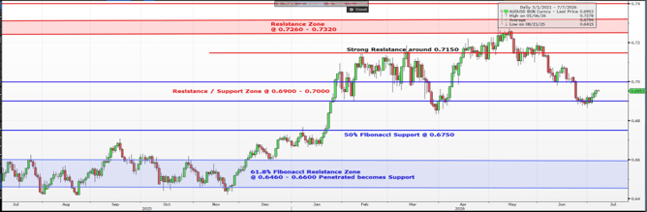
At its 16 Jun MPC meeting, RBA left the OCR unchanged at 4.35%, marking the first pause after three consecutive 0.25% hikes in Feb, Mar and May. AUDUSD will likely be weighed down and enter into a correction phase without further rate increases. The June 2026 ABS Business Conditions and Sentiments survey suggests Australia's economy remains in a below-trend growth environment. This should add downside pressure.
As expected, in June, AUDUSD continued its decline, testing the support zone at 0.6900 – 0.7000. We should see some consolidation in this Zone before a further fall towards 50% Fibonacci Support at 0.6750.
EURUSD
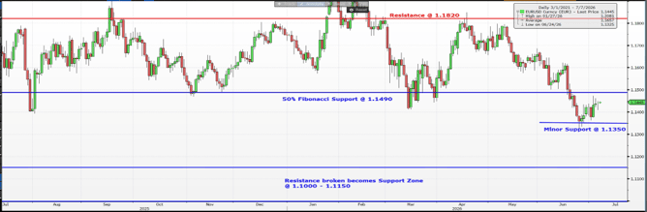
On 11 June, the ECB delivered a widely expected 0.25% rate hike in response to inflation pressures, particularly higher energy prices. This is the first increase since 2023. The market believes there should be no further tightening until additional data becomes available to clarify the outlook for inflation and growth.
In response, EURUSD has dropped below the 50% Fibonacci Support at 1.1490, as was expected in our June analysis. After some consolidation above minor support around 1.1350, a further fall to the 1.1000 – 1.1150 Support Zone should follow.
Image Source: Bloomberg 07 Jul 2026
GBPUSD
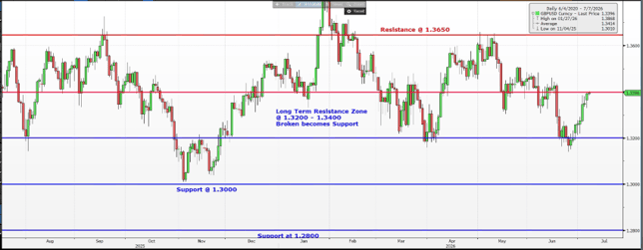
The Financial Times reported that the BoE is pressing ahead with plans to limit hedge fund leverage in key funding markets. These minimum repo haircuts may impact liquidity in normal times, but should reduce the odds of a disorderly unwind in a crisis. This is against a backdrop of the UK’s political instability, with the recent forced resignation of PM Keir Starmer compounding economic and social problems. GBPUSD should be under pressure over the next few months.
As anticipated in our June analysis, GBPUSD dropped to test the 1.3200 – 1.3400 Support Zone, which provided support for a bounce to the 1.3400 Resistance. We do expect GBPUSD to move down to break through the 1.3200 Support in the coming weeks.
Image Source: Bloomberg 07 Jul 2026
USDJPY
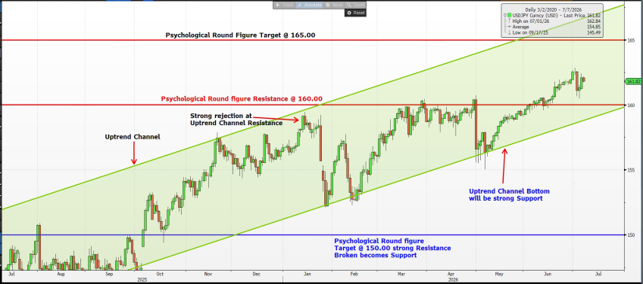
At its 16 Jun MPC meeting, BoJ struck a hawkish note, raising its policy rate by 0.25% to 1.00%. This is the highest rate in 31 years, indicating that medium to long-term inflation expectations continue to rise. It is expected to hike by another 0.25% in Q4. However, this did not help the JPY with USDJPY testing 40-year highs. Intervention risk is rising, but not likely until the 165.00 level.
USDJPY is still moving in the Uptrend Channel. We expect it to challenge the 165.00 level, with some pullbacks along the way.
Image Source: Bloomberg 07 Jul 2026
USDSGD
Analysts say the SGD is set to gain despite a hawkish Fed, likely due to inflows from funds driven by the Republic’s safe-haven reputation. Over the last few weeks, the SGD has gained more than 4% against its neighbour, the Malaysian Ringgit, and likewise against other ASEAN currencies.
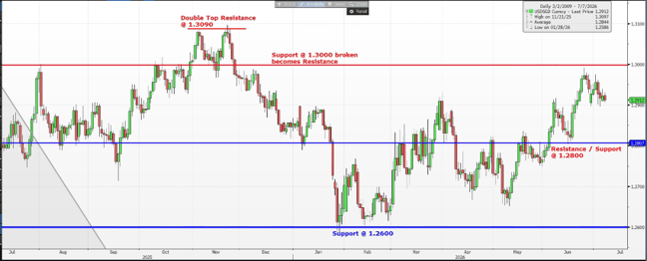
A stronger USD has pushed USDSGD out of our expected 1.2600 – 1.2800 range and into a challenge of the 1.3000 Resistance. USDSGD should trade between 1.2800 and 1.3000 in the coming weeks with a downward bias. We still expect to see USDSGD down to the 1.2600 level later this year.
Image Source: Bloomberg 07 Jul 2026
AUDSGD
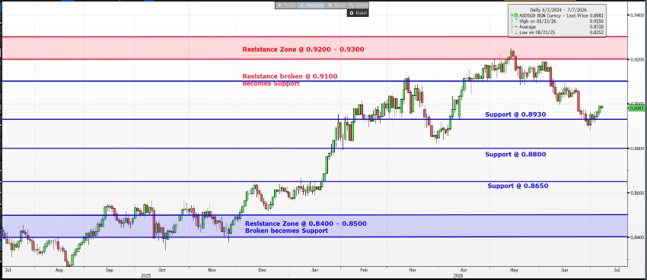
Over June, AUDSGD has fallen back to 0.8930, as expected, but has found support. AUDSGD is likely to oscillate around the current level, with a downward bias toward 0.8800.
Image Source: Bloomberg 07 Jul 2026
XAUUSD
June’s big news is that for the first time in 30 years, Gold has overtaken US Treasuries as the largest single asset class in global official reserves. According to the European Central Bank, at the end of 2025, gold accounted for 27% of total official reserves, ahead of US Treasury bonds at 22%. But the narrative that Central Banks will keep buying Gold is likely over, as evidenced by the year-to-date price decline of more than USD1,400.
Gold has remained below the 50-Day Moving Average since mid-March, and our technical wave count target of USD4,000 for the next Support area has been hit. We can expect a range between USD4,000 and USD4,500 over the next few weeks, but do not rule out further XAUUSD declines to USD3,500.
Image Source: Bloomberg 07 Jul 2026
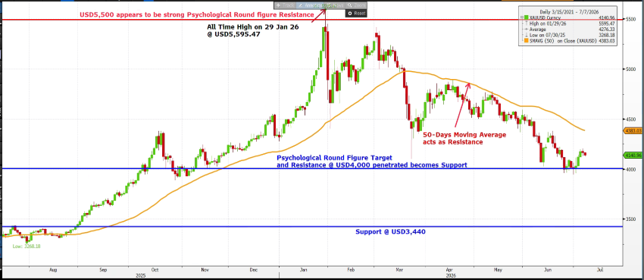
Note: In the Candlesticks Chart, Green bars mean the Close is higher than the Open price, and Brown bars mean the Close is lower than the Open price
Escalating US and Israeli strikes on Iran have rattled global markets, amplifying geopolitical and economic uncertainty into 2026 amid tariff...
Global markets remain resilient despite rising oil prices and economic uncertainty driven by the US/Israel-Iran war.
Global markets are reeling from the US-Israel-Iran war, with surging energy prices, weakening currencies, and growing recession fears dominating the...