This outlook contains information correct as at 1400hr on 01 Sep 2026
Fed Hawkish Pivot Raises Rate Hike Odds
On August 28, Federal Reserve Chair Kevin Warsh made his Jackson Hole debut. He emphasised a return to data-driven decision-making, emphasising a 2% inflation target. “Here is my standard: We must be confident that underlying inflation is moving to our objective, clearly and at sufficient speed. Otherwise, we have work to do”. Markets interpreted this as hawkish, and the odds for an interest rate hike at this month’s 15 - 16 September FOMC meeting rose from 35% to 64%.
His assessment of the US economy is constructive, against a backdrop of a labour market representative of full employment with supportive financial conditions driving resilient consumer demand. Business capex remains strong, and AI adoption and investments could drive profitability and long-term growth. Markets will look to August employment numbers, with the Reuters median economists’ estimate for Non-Farm Payrolls is 55,000 jobs added.
China's Growth Momentum Collapses
As we enter the second half of 2026, the tech boom and high-end exports have failed to lift China’s economy. Fixed-asset investment saw a bigger than forecast decline of 6.7% in the first seven months. Retail sales growth slowed to 0.6%, while the surveyed urban jobless rate climbed to 5.2%. Societe Generale SA economists said the country’s growth momentum is “collapsing” outside tech. “China’s economic data continue to disappoint, with an increasingly K-shaped pattern, strong tech but weakness almost everywhere else”. With Q2 economic growth below the Government’s annual target of 4.5%-5%, authorities face a tough time reviving business and household spending.
Ernan Cui of Gavekal Dragonomics, a consultancy, recently pointed out that despite all of the headline-grabbing advances in technology, China’s development took a step backwards last year. According to The Economist, the number of Chinese people working in agriculture last year rose by about 26 million above the 2019 pre-COVID trend, only the second time this century. Migrant workers are disappearing into the countryside from disappearing jobs in urban centres.
Climate Tech & Geopolitical Risks
Looking ahead, investments in power and climate mitigation, in particular, heat technologies will increasingly be more critical, for example:
1. Buildings clad in thin-film solar panels that power the air conditioning system. These films can be made in any colour to suit architectural needs
2. Eco-friendly fire retardants to spray on vegetation to fireproof them, reducing or even eliminating wildfire risks
3. Technology to cheaply make large quantities of dry ice (frozen carbon dioxide) to drop this instead of water to kill wildfires
Geopolitical risks from the ongoing Iran situation will keep oil prices elevated, but the top side is being kept in check as crude continues to flow through the Strait of Hormuz. Roughly 6 million to 8 million barrels a day of crude are now being shipped through this chokepoint as producers across the Middle East boost exports. WTI is traded around USD85.50 per barrel.
Overnight, US 10-Year Treasuries closed up 0.03% at 4.78% (4 Aug 4.68%), Australian 10-Year Govt Bonds closed up 0.08% at 5.17% (4 Aug 4.94%), and Euro 10-Year Bonds closed up 0.05% at 3.32% (4 Aug 3.15%).
Sources: Bloomberg, MSNBC, Reuters, Morningstar, Business Times, 01 Sep 2026
Currency Focus
USD Index (DXY)
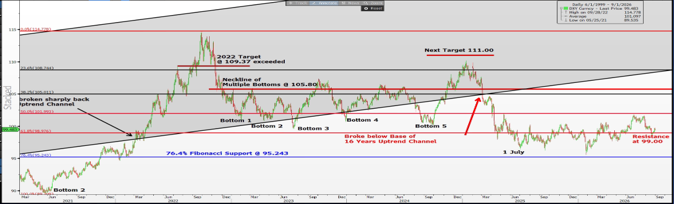
In our update on 6 Jan 2026, we indicated “USD found strong support before the 76.4% Fibonacci Support of 95.243, and by late September 2025 was on its way up. We are likely to see a stronger DXY in 2026.” For H1 of this year, the USD has been on an uptrend with DXY hitting a high of 101.80 on 24 June. DXY has suffered a setback over the last two months but is seeing support around the 99.00 level. We maintain DXY, i.e. the USD should recover by the year-end.
Image Source: Bloomberg 01 Sep 2026
AUDUSD
RBA is expected to keep the 4.35% OCR unchanged at its 29 Sep meeting. However, the Trimmed Mean inflation remains sticky at 3.6% YoY, and this could prompt a 0.25% rate hike later this year, especially if domestic demand proves more resilient than expected. This should continue to support AUDUSD.
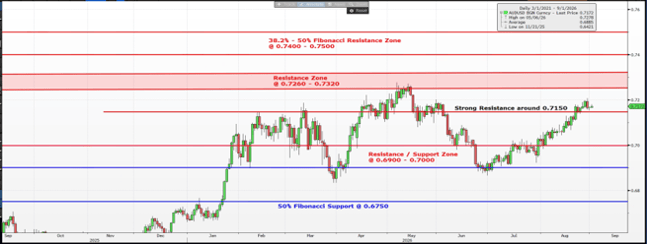
Our expected AUDUSD down move did not happen; instead, it pushed strongly past the resistance at 0.7000 and is now challenging the strong Resistance at 0.7200. Momentum is strong, and AUDUSD is likely to move higher to challenge the Resistance Zone at 0.7260 – 0.7320. We then expect the rally to exhaust here.
Image Source: Bloomberg 01 Sep 2026
EURUSD
As widely expected, the ECB left all three policy rates unchanged at its 23 Jul meeting, keeping the deposit rate at 2.25%. Policymakers needed time to assess the inflationary implications of the recent energy shock and its effects on the Eurozone. The next ECB meeting will be on 10 Sep, where a 0.25% rate hike is expected, bringing the deposit rate to 2.5%. Economic weakness in the Eurozone should put the EURUSD under continuing pressure.
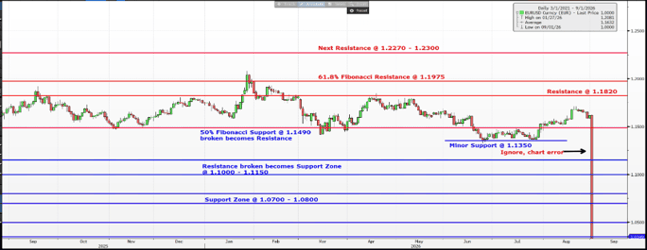
EURUSD is consolidating within the minor support at 1.1350 and the 50% Fibonacci Resistance at 1.1490. After this consolidation, we can expect a fall to the 1.1000 – 1.1150 Support Zone.
Image Source: Bloomberg 01 Sep 2026
GBPUSD
For GBPUSD, interest rate expectations should be the biggest drivers; the pair might face downward pressure as the Fed appears to be turning more hawkish with increased probability of a Fed September rate hike. Furthermore, investors pared back expectations for a Bank of England rate hike this year.
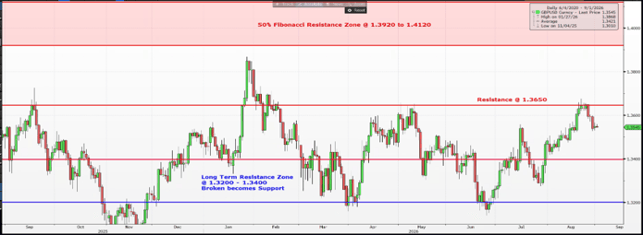
GBPUSD rallied higher in August to challenge Resistance at 1.3650. The rally appears to have exhausted itself, and we maintain our view for GBPUSD to move down for a test of the 1.3200 – 1.3400 Support Zone again.
Image Source: Bloomberg 01 Sep 2026
USDJPY
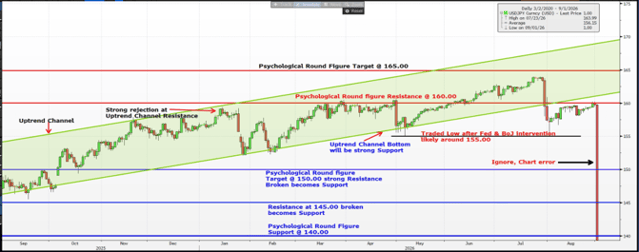
Multiple news sources cited Japanese Ministry of Finance officials saying Japan spent roughly USD 96.5 billion defending the Yen for the period 30 July - 26 August 2026. The intervention drove USDJPY down to around 155.00 from just below 164.00. However, the intervention does not appear to be very effective as the market has brought the rate back up to the 160.00 psychological Resistance level. The latest news is BoJ may hike the interest rate this month.
USDJPY has moved up to test the 160.00 level again. We expect USDJPY to vacillate around here before another push might bring it back into the Uptrend Channel.
Image Source: Bloomberg 01 Sep 2026
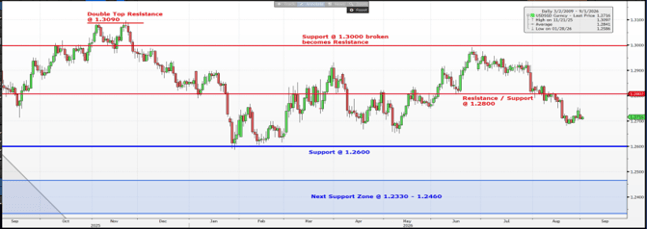
USDSGD
Continued funds inflows have seen the SGD strengthen vis-à-vis the USD against expectations of higher USD interest rates and continuing low SGD interest rates. We maintain a view for USDSGD to move lower to test and eventually break the 1.2600 Support.
Image Source: Bloomberg 01 Sep 2026
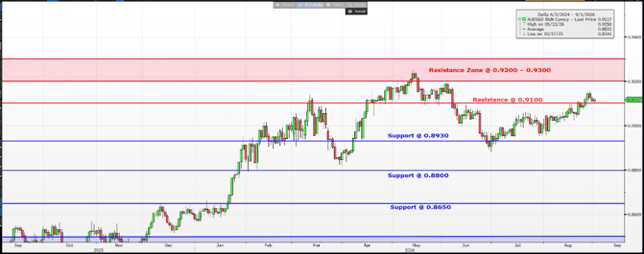
AUDSGD
AUDSGD is trying to remain above the resistance at 0.9100. We believe the rally is at its end, and AUDSGD should head back down again towards 0.9000.
Image Source: Bloomberg 01 Sep 2026
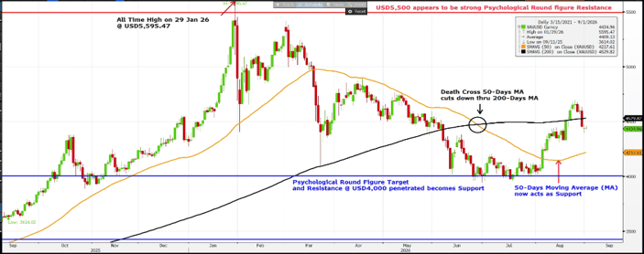
XAUUSD
Gold rallied strongly in August, breaking above both the 50-Day and 200-Day Moving Averages. The rally is likely due to speculators taking profits and late comers who missed the move to the USD5,500+ levels buying this pullback. This is unlikely to sustain its price.
At the August month-end close, XAUUSD has fallen back below the 200-Days Moving average. Technically, this is a negative signal, and in the coming weeks, we can expect Gold to fall back to the 50-Day Moving Average line around USD4,200, which acts as a Support.
Image Source: Bloomberg 01 Sep 2026
Note: In the Candlesticks Chart, Green bars mean the Close is higher than the Open price, and Brown bars mean the Close is lower than the Open price