Australia
Private Credit Weekly Insights, 20 June 2025
ABS labour force data for May 2025 reflects a resilient but moderating labour market
Monetary Policy Decision

On Tuesday, the RBA increased the cash rate by 25 basis points to 4.10%, marking a second consecutive hike and reflecting a more hawkish shift in response to persistent inflationary pressures. The decision was narrowly split, although the divergence centred on timing rather than direction, reinforcing the Board's alignment on the need to contain inflation.
While inflation has eased from its 2022 peak, it reaccelerated through the second half of 2025, with recent data indicating that price pressures are being driven not only by temporary factors but also by underlying capacity constraints in the domestic economy. This dynamic has been exacerbated by the escalation of the Middle East conflict, which has driven oil prices above US$100 per barrel and materially lifted fuel costs, adding to near-term inflation and pushing inflation expectations higher.
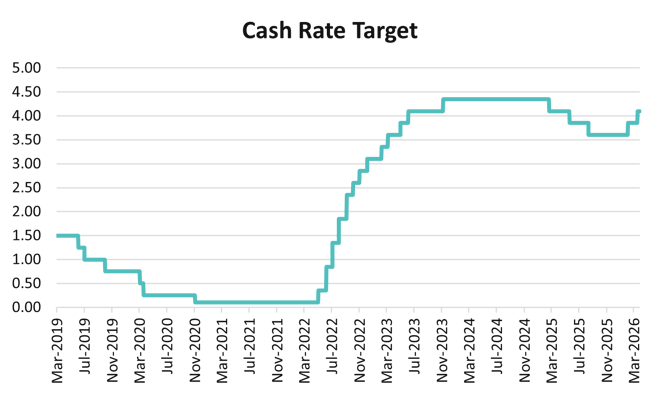
Domestically, the economy continues to exhibit resilience, with stronger-than-expected private demand momentum in late 2025 and ongoing tightness in labour market conditions. The unemployment rate remains low, and labour underutilisation is subdued, contributing to elevated wage and cost pressures. Notably, economic growth has been running above the pace consistent with stable inflation, reinforcing the RBA’s assessment that demand is exceeding supply capacity. While business investment has surprised to the upside, consumption has been comparatively softer, and housing market conditions remain firm despite some early signs of moderation. Financial conditions have tightened modestly, though credit availability remains supportive, and the lagged effects of prior easing in 2025 have yet to fully transmit through to activity, prices, and wages.
For domestic private credit, the policy outlook is increasingly characterised by a “higher-for-longer” rate environment, with money markets now pricing a meaningful probability of further tightening in the coming months. Elevated base rates will continue to support income generation; however, the persistence of inflation and rising funding costs is expected to place incremental pressure on borrower cash flows, particularly in sectors exposed to discretionary consumption and cost volatility. The pass-through of higher interest rates, alongside rising fuel and input costs, will be a key driver of credit performance over the next 6–12 months, reinforcing the importance of conservative structuring, robust covenants and active portfolio monitoring.
Source: Reserve Bank of Australia, Monetary Policy Decision, Australia, March 2026.
ABS labour force data for May 2025 reflects a resilient but moderating labour market
March Quarter CPI. A quick look at what is driving CPI figures in Australia