PRIVATE CREDIT
Aura Private Credit Weekly Insights - 18 November
This week, the wage price index demonstrated that real wages are struggling to keep up with the rate of inflation
Private Credit in the Press and Consumer Price Index
.png)
Private credit in Australia has had an interesting week, and it's worth addressing directly. Bathla Group, the Sydney-based property developer behind Universal Property Group and Raj & Jai Construction, entered voluntary administration on 25 August, with Teneo appointed as administrators of some $3.2 billion in liabilities, most of which is owed to private credit lenders.
Three fund managers have since moved to manage redemptions, though for quite different reasons: Centuria Bass fully suspended redemptions and new applications on its Bass Credit Fund and Bass Property Credit Fund for an expected two to six months, after direct lending across several Bathla facilities left it now funding subcontractors directly on near-complete projects. CVS Lane has also suspended redemptions across two of its funds due to Bathla exposure. MA Financial, by contrast, introduced a modest monthly redemption cap on its MA Secured Loan Series with no direct Bathla exposure — a precautionary measure the manager attributes to broader investor sentiment in the sector rather than any loan-book connection to Bathla. As with any developer administration, the real question for affected lenders isn't the headline exposure figure but the security they hold — ranking (first vs second mortgage), loan-to-value at origination, and how complete the underlying projects are all drive the eventual recovery rate, and it's this, not the fact of the administration itself, that will determine whether any lender ultimately faces a shortfall.
Aura Private Credit has no direct or indirect exposure to Bathla Group across any of our funds. Redemptions are continuing to be processed in the ordinary course and in line with our fund terms, with no gates or caps in place. We're always glad to talk investors through our portfolio and lending standards and will keep you posted as the broader private credit picture develops.
A key point of differentiation for our fund is that we do not finance property development.
Australia’s inflation outlook has taken a more hawkish turn following a stronger-than-expected July CPI release. Headline CPI inflation eased to 3.5% year-on-year, from 3.8% in June and its lowest annual rate since November, but remained well above the 3.3% expected by economists. More importantly, trimmed mean inflation was 3.6%, unchanged from June but above expectations of 3.5%. The result suggests the moderation in headline inflation has yet to translate into a meaningful easing in underlying price pressures.
Services inflation remained elevated at 3.7%, reflecting persistent domestic price pressures linked to wages and labour costs. Housing was the largest contributor to annual inflation, rising 5.0%, while food and non-alcoholic beverages increased 3.2%. Transport was the largest contributor to the monthly increase, rising 2.6% as the government’s fuel excise relief began to unwind.
Markets responded sharply, now pricing close to a 40% probability of a September hike, while the probability of at least one increase by year-end has risen above 80%, both are material increases from prior to the release. Economist forecasts have also shifted. Deutsche Bank now expects a 25bp increase at the RBA’s September meeting, while ANZ became the first of the Big 4 to forecast a November increase, joining Goldman Sachs.
The key uncertainty is whether the July result is enough to trigger a September move. The RBA places greater weight on quarterly inflation data, as monthly CPI can be affected by one-off price movements.
This suggests that while the result increases the risk of a November hike, it may not be enough to make one the base case. Further labour-market, activity and inflation data will be important ahead of the September meeting to determine a data-defined trend for the RBA.
Overall, the July CPI has materially shifted the interest-rate outlook. Headline inflation is moderating, but persistent underlying and services inflation remains inconsistent with the RBA’s target. Market reactions indicate that the September meeting is now genuinely “live”, as the RBA’s warnings of upside risks to its inflation forecasting threaten to materialise.
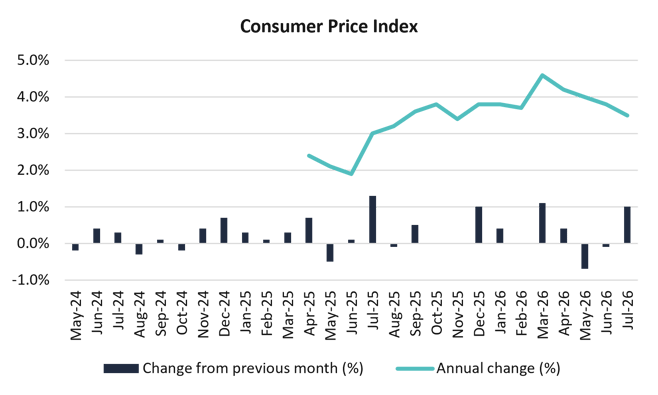
Source: Consumer Price Index, Australia, July 2026.
This week, the wage price index demonstrated that real wages are struggling to keep up with the rate of inflation
Business conditions improved in June 2025, with rising confidence, investment, and easing inflation supporting growth
ABS labour force data for May 2025 reflects a resilient but moderating labour market