Calls to slow AI are positioning. A developer asking for a pause is telling rivals it thinks its own model is far ahead, and telling regulators it welcomes oversight.

A handful of American models, with Chinese rivals close behind, are racing towards artificial general intelligence (AGI), frontier models that outpace human intelligence. The race is also a geopolitical battle over who captures the largest productivity gains and controls the supply chains robotics will rebuild.
The job losses will be real; it is hard to say what a university graduate should study today. But predictions of AI wiping out humanity distract from the tension already here: longer lives and shorter careers. The technology taking our work is the same one promising us more years to live. Medicine is where AI lands next, and hardest.
Harnessed properly, AI lifts productivity enough for the economy to grow fast without stoking inflation. Living standards follow, but only if the gains are shared. Yet the early money goes to capital, not labour. AI cannot be stopped; what can change is the capital-labour split, and it must: no society tolerates a permanently lopsided one.
Nobody slows down
No company, let alone a country, has a reason to ease off. Nobody who is winning wants a pause, and nobody who is losing can afford one: every player faces the same payoff matrix, and the dominant strategy is to run.
Countries will commit more than US$100 billion to sovereign AI compute this year on Deloitte’s count, against US$400 billion to US$450 billion of global AI data-centre spending, but roughly 90% of the compute in the world’s leading AI supercomputers sits in the United States and China. A country without its own compute rents it from America or China, on their terms.
METR measures how long a task an AI agent can complete unaided. That horizon doubled every seven months from 2019 to 2025 and faster still, roughly every four months, over 2024–25. By February 2026 the leading systems could complete software tasks that take a human expert a full working day. On that trend a working week arrives before the end of 2026.
We expect capability to keep advancing towards AGI, but adoption will be uneven. We cannot yet call the winners and losers with complete accuracy.
White collar first, then the robots
The first jobs to go are junior white-collar roles, and white-collar work is the well-paid end of the labour market. On Morgan Stanley’s numbers the most exposed occupations carry an employment-weighted median salary of about US$97,000, against about US$46,000 for the least exposed.
Firms rarely start with redundancies. They stop hiring graduates, stop replacing leavers and push the work onto existing staff. Headcount falls without a single redundancy being announced. Margins improve in the short run. The cost comes later: junior work is how a firm trains its future senior staff, and without it the next generation of partners is never made.
Learning the tools protects the worker who learns them. It does not protect the team’s size: a team can get better and smaller at the same time.
Consider the next iteration, the humanoid supply chain. Unitree’s Shanghai listing in August 2026 captured the appetite: oversubscribed more than 8,000x by retail investors, up 460% at the close on day one (peaking at 629% intraday), then down almost half within a week. The price action says more about speculation than about robots, but the scale of the bid says the market has already decided humanoids are the next trillion-dollar industry. Goldman Sachs has since lifted its base case for humanoid shipments to 75,000 this year and 6.5 million in 2035.
Chart 1: Goldman Sachs humanoid shipment forecast, previous and revised
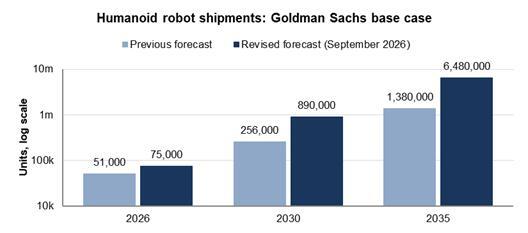
Source: Goldman Sachs, Physical AI report, September 2026. Base-case global shipments, units, 2026, 2030 and 2035.
Robotics is also where the supply chain battle is fought, because whoever automates the factory, the warehouse and the port sets the cost of making and moving goods. Nor is automation waiting for humanoids: China installed 295,000 conventional industrial robots in 2024, 54% of the world’s total. Warehouses, logistics and car plants go first because the environment is controlled; the tradesperson who walks into a different house every morning goes last. Reliability, autonomy and cost decide the timing, and uneven adoption can still be large enough to move wages.
Transport is next, and physical work stops being safe ground: Uber’s chief executive can imagine most of its trips being fulfilled by robots in 15 to 20 years. We expect it sooner, in as little as 10 years. Expect robot uptake to be as parabolic as ChatGPT’s was after 2022.
AI, drugs and the robot surgeon
AI designs the drug; robots run the experiment, then the operation. In August 2026 Anthropic let AI agents run lab equipment and robotic arms in a research preview. It still needs supervision, but the automation replacing office work now runs experiments.
AlphaFold is the proof point: sixty years of laboratory work had mapped the structure of 0.1% of the 200 million known proteins, and AI predicted the rest in under a year. A predicted structure is not a drug, but it can remove years of early work from drug discovery. On Capgemini’s estimates, target to pre-clinical candidate falls from four or five years to 12 to 18 months.
Gene editing extends AI’s role from finding medicines to designing the tools that alter DNA. In human-cell tests, an AI-designed version of CRISPR, the molecular scissors used to edit genes, matched a standard editor’s activity at the intended sites, with 95% less unintended editing across the sites tested.
Drug development takes more than a decade, and each drug that reaches market costs up to US$2 billion once failures are counted; only one in ten entering trials is approved. Time and failure are the bottlenecks, and AI attacks both: better candidates in Phase I, better-matched patients and smaller trials in Phase II, fewer failures in Phase III.
On robotics, surgeons used da Vinci systems in about 3.15 million procedures in 2025, up 18%, and in July 2025 a Johns Hopkins robot completed a lengthy phase of a gallbladder removal on pig tissue unaided. Surgeons are not immune: first the robot assists, then it operates while the surgeon supervises.
Novo Nordisk partnered with Anthropic in September 2026; Lilly, Merck and Roche have made similar bets. Investors have committed before the science has proved itself: UBS counts about 850 AI-developed drugs in progress, none yet approved in the United States, and the count is growing fast.
Prevention is moving in parallel: 11% of American adults now take a GLP-1 drug for weight loss, from 3% two years ago, and the diabetes rate has eased to 12.8%, its first reading under 13% since 2022. Medical technology has usually raised health spending by keeping people alive longer in poor health; GLP-1s are the clearest mass-market exception since vaccination, because they cut the risk of the disease itself.
Chart 2: GLP-1 use and adult obesity in the United States
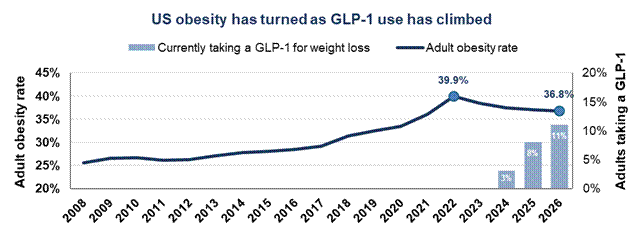
Source: Gallup National Health and Well-Being Index, July 2026, revised 8 September 2026. Share of US adults currently taking a GLP-1 for weight loss, 2024 to 2026; adult obesity rate, 2008 to 2026.
Longevity, and who pays for it
Put AI’s channels together, faster discovery, gene editing and robotic surgery, and the destination is longevity. We will still age. The aim is to spend our last 15 to 20 years in better health. The lifespan-healthspan gap (years lived in poor health) is 9.6 years globally and 12.1 in Australia, and widening. Those years consume the health budget; they are what AI medicine targets.
Insilico Medicine’s rentosertib, a lung-fibrosis drug whose target and molecule AI both found, entered Phase III in July; a Nature Biotechnology study this month ran its Phase II bloods through six proteomic ageing clocks. In one treatment group, four clocks showed roughly three-year reductions in predicted biological age from baseline at week four. With 42 patients, and slower ageing not yet disentangled from a treated lung, the ageing read is exploratory. It is the first clinical read-through of its kind and will not be the last.
London Business School economist Andrew Scott prices each extra healthy year at 3% to 4% of US GDP a year, a measure of welfare rather than output. The benefits need not stay with the wealthy: discovery is the expensive part, a drug is cheap to make once it exists, and patents and funding set how fast it reaches everyone.
The bigger problem sits outside the hospital. Superannuation and insurance rest on actuarial assumptions built around retiring at 65, and every one of them moves. We tell people longer lives will be paid for by working longer while investing in technology designed to need less of their labour. Each proposition is sensible alone; together they demand an answer to who employs the healthier 65-year-old, and nobody has one.
Five extra healthy years are five more years of earning and saving for someone still employed, and five more years of drawing down for someone whose occupation has shrunk. The biology is identical. The finances are decided by what you own.
Care costs could absorb much of the gain. Productivity in Australia’s non-market sector, health and care above all, sits below its 2007 level, and the NDIS alone costs A$56 billion a year. That is the cost disease of the service economy: care is labour, its productivity does not grow, so its relative price rises as everything else gets cheaper and it takes an ever-larger share of income. No amount of drug discovery cures that.
That is where robotics comes back in, from the operating theatre to the home. Hospitals and homes were built for humans, the strongest argument for machines shaped like them; Japan’s care robots are the early example. If AI drugs extend healthspan and care robots make the remaining treatment affordable, the cost disease finally has a treatment. Shipment forecasts say nothing yet about care costs. None of this makes AI the wrecking ball it is billed as; the benefits have to survive the politics.
The politics arrive in November
The US midterms on 3 November are the first test. A lost job in a town is a political event; a productivity statistic is not. The national accounts already show the transfer: labour’s share of American output is the lowest since recording began in 1947, profits a record. Can American capitalism carry a middle class with little capital?
The worst case: the top 1% takes more, the middle hollows and the anger turns on the technology, not the distribution. Rome is the old warning: wealth concentrated, farmers lost their land, the republic fell.
No company can cut its payroll and assume its customers’ incomes are untouched; one firm’s wage bill is another’s revenue. Household wealth increasingly sits in AI stocks: the wealth effect holds up the consumer, AI holds up the wealth effect, and AI is coming for the incomes of the households that own it. Goldman’s US discretionary basket has lagged its AI basket by 17% this year. Investors have chosen AI over the consumer; spending has not yet given way. The first leg of the transfer lifts earnings.
China is running hard, and on frontier models it is a close second at worst: Epoch AI’s tracking puts its best models about seven months behind, on average, the American leaders at a fifth to a tenth of the price. On everything downstream of the model it is already ahead. AI runs on electricity, and China built its grid before it needed it; American data centres queue for years to connect.
It is easy to see the Chinese authorities directing AI at cheaper, higher-quality social services, while the American version, so far, enriches the people who build it. China’s unique capitalism-lite model lets the state direct the gains, and its legitimacy rests on a guarantee to its people, above all the middle class, that living standards keep rising. The test for both is whether the gains reach citizens, and on that count China may be better placed.
What it means for investors
The transfer to capital favours shareholders in aggregate, but exposure to AI is not an investment case by itself. The entry price matters, and the business must keep some of the gains.
AI makers must earn a return on heavy capital spending. For users, the opportunity is a cost base that can shrink without revenue shrinking with it. A firm paid for an outcome may keep the saving; one paid by the hour or per user may lose revenue. Pricing power and proprietary data help protect the benefit as rivals adopt the same tools. Claims processing, bank and insurer back offices and fixed-fee professional services fit best.
The evidence is in the accounts, not the announcements: rising output per employee, and better cash margins after the cost of models, integration and supervision.
Australia has the most to gain and the greatest urgency: labour productivity is barely 1% above its 2015 to 2019 average, and AI is the one productivity lever that needs no legislative reform. Among Australian small and mid-sized companies the advantage is speed of implementation: turning a decision into a working system quickly and capturing the savings sooner. The ASX20 is largely stranded and legacy.
Healthcare is where the change runs deepest: AI discovery, gene editing and robotics remake how medicine is found and delivered. For big pharma it cuts both ways, answering the patent cliff while making today’s drugs obsolete; the incumbents have the cash to buy in either way. Prevention will also make some healthcare businesses redundant.
In robotics, the earlier opportunity rests with industrial adopters, not robot manufacturers. Could that save the German car industry? BMW has tested it: a Figure robot supported production of more than 30,000 X3s in ten months at its US plant in 2025, and BMW has since begun a second humanoid pilot, with a different robot maker, at Leipzig.. Robots make BMW’s cars cheaper to build. But they do not make more people want to buy them.
For rates, the build-out is inflationary while power, chips and builders are scarce; the outcome is potentially deflationary. Once the infrastructure is in place the economy does more with less, and growth runs faster without the same pressure on prices. Policy rates would likely be higher, but not restrictive, because the growth is not inflationary. Ten-year yields should fall as the inflation premium fades, leaving a flatter curve. This is what we describe as the Goldilocks economic scenario.
Living with AI
We hope the shift from labour to capital is short-lived. Hope is not a forecast. Whether the shift reverses depends on politics.
We would be wrong if an international agreement slowed the race to AGI, if the American labs regained a decisive lead and kept prices high, or if implementation costs and competition ate the savings. So would AI drugs still failing in the clinic in 2028, or windfall taxes and public stakes after November that cut the return to capital.
Greater longevity is arriving. Careers too short to fund it are the default if nothing changes. Two things can change it: wider capital ownership and policy that spreads the gains. We will live longer with AI in both senses: more healthy years because of it, more years alongside it. The technology does not decide who benefits; owning a share of the capital does.
Sources
- Deloitte, “TMT Predictions 2026: The AI gap narrows but persists”, Deloitte Insights, 2026 (sovereign AI compute; AI data-centre capital expenditure). https://www.deloitte.com/us/en/insights/industry/technology/technology-media-and-telecom-predictions.html
- UN Independent International Scientific Panel on AI, preliminary report, July 2026 (share of leading AI supercomputer compute held by the US and China). Coverage: https://thenextweb.com/news/un-scientific-panel-ai-governance-warning
- METR, “Measuring AI Ability to Complete Long Software Tasks”, 19 March 2025. https://metr.org/blog/2025-03-19-measuring-ai-ability-to-complete-long-tasks/
- METR, “Time Horizon 1.1”, 29 January 2026. https://metr.org/blog/2026-1-29-time-horizon-1-1/
- Morgan Stanley, US economics research on AI exposure and “CHIC” households (Heather Berger), 2026. [to confirm: report title, date, and that it contains the salary figures]
- The Asset, “Unitree Robotics soars 629% on trading debut”, 19 August 2026. https://www.theasset.com/article/56931/unitree-robotics-soars-629-on-trading-debut
- Goldman Sachs, Physical AI report, September 2026 (humanoid shipment forecasts, Chart 1).
- International Federation of Robotics, World Robotics report (2024 industrial robot installations).
- Fortune, “Uber CEO predicts most rides could be robot operated within 20 years”, 23 February 2026 (Dara Khosrowshahi, The Diary of a CEO). https://fortune.com/2026/02/23/uber-ceo-dara-khosrowshahi-robotaxis-autonomous-vehicles-diary-of-a-ceo-podcast/
- Anthropic, “Previewing the Model Hardware Standard”, 27 August 2026. https://www.anthropic.com/news/model-hardware-standard-research-preview
- Google DeepMind and EMBL-EBI, AlphaFold Protein Structure Database. https://alphafold.ebi.ac.uk
- Capgemini Research Institute, AI in biopharma research, 2026
- Profluent, “Design of highly functional genome editors by modelling CRISPR–Cas sequences”, Nature, July 2025 (OpenCRISPR-1). https://www.businesswire.com/news/home/20250730820469/en/Profluent-Announces-Publication-of-Generative-AI-Research-in-Nature-with-New-Results-for-OpenCRISPR-1
- Biotechnology Innovation Organization (BIO), Informa Pharma Intelligence and QLS Advisors, “Clinical Development Success Rates and Contributing Factors 2011–2020”, February 2021. https://www.bio.org/gooddaybio-archive/nasdaqs-ceo-biopharma-diversity-and-gamestop
- Drug development cost per approved drug (up to US$2 billion). [source to be added]
- Intuitive Surgical, 2025 annual results (da Vinci procedure volumes).
- Kim, J.W. et al., “SRT-H: A hierarchical framework for autonomous surgery via language-conditioned imitation learning”, Science Robotics, July 2025 (Johns Hopkins University). https://hub.jhu.edu/2025/07/09/robot-performs-first-realistic-surgery-without-human-help
- Novo Nordisk, “Novo and Anthropic will collaborate to advance drug discovery with Claude”, 16 September 2026. https://www.globenewswire.com/news-release/2026/09/16/3363106/0/en/novo-and-anthropic-will-collaborate-to-advance-drug-discovery-with-claude.html
- UBS, AI-developed drugs in development. [to confirm: report title, date, and whether the ~850 count includes preclinical programs]
- Gallup, National Health and Well-Being Index, July 2026, revised 8 September 2026 (GLP-1 use and obesity, Chart 2).
- Garmany, A. and Terzic, A., “Global Healthspan-Lifespan Gaps Among 183 World Health Organization Member States”, JAMA Network Open, December 2024 (Mayo Clinic). https://doi.org/10.1001/jamanetworkopen.2024.50241
- Insilico Medicine and collaborators, rentosertib proteomic ageing-clock study, Nature Biotechnology, 7 September 2026.
- Insilico Medicine, Phase III announcement for rentosertib, July 2026.
- Insilico Medicine, “Insilico Medicine Doses First Patient in GENESIS-IPF-3, the World’s First Phase III Trial of a Generative AI-Driven Innovative Drug”, 10 September 2026. https://insilico.com/news/isn1009261-insilico-medicine-doses-first-patient-genesis-ipf-3
- Scott, A.J., Ellison, M. and Sinclair, D.A., “The economic value of targeting aging”, Nature Aging 1, 616–623 (2021). https://doi.org/10.1038/s43587-021-00080-0
- Australian non-market sector productivity (ABS / Productivity Commission); NDIS annual cost (NDIA / Federal Budget). [sources to be added]
- US Bureau of Labor Statistics, “Labor share at its lowest level, 52.8 percent, in second quarter 2026”, The Economics Daily, 2026. https://www.bls.gov/opub/ted/2026/labor-share-at-its-lowest-level-52-8-percent-in-second-quarter-2026.htm
- Goldman Sachs, US discretionary vs AI basket performance. [to confirm: report title and date]
- Epoch AI, “Chinese AI models have lagged the US frontier by 7 months on average since 2023”, 2 January 2026. https://epoch.ai/data-insights/us-vs-china-eci
- Chinese model pricing and US data-centre grid connection queues.
- Australian labour productivity vs 2015–19 average (ABS / RBA).
- BMW Group, “BMW Group advances the use of Physical AI in production with Figure 03 project in Spartanburg”, 25 June 2026. https://www.press.bmwgroup.com/global/article/detail/T0458778EN/bmw-group-advances-the-use-of-physical-ai-in-production-with-figure-03-project-in-spartanburg?language=en
- BMW Group, “BMW Group to deploy humanoid robots in production in Germany for the first time”, 2026. [to confirm: release date] https://www.press.bmwgroup.com/global/article/detail/T0455864EN/bmw-group-to-deploy-humanoid-robots-in-production-in-germany-for-the-first-time?language=en